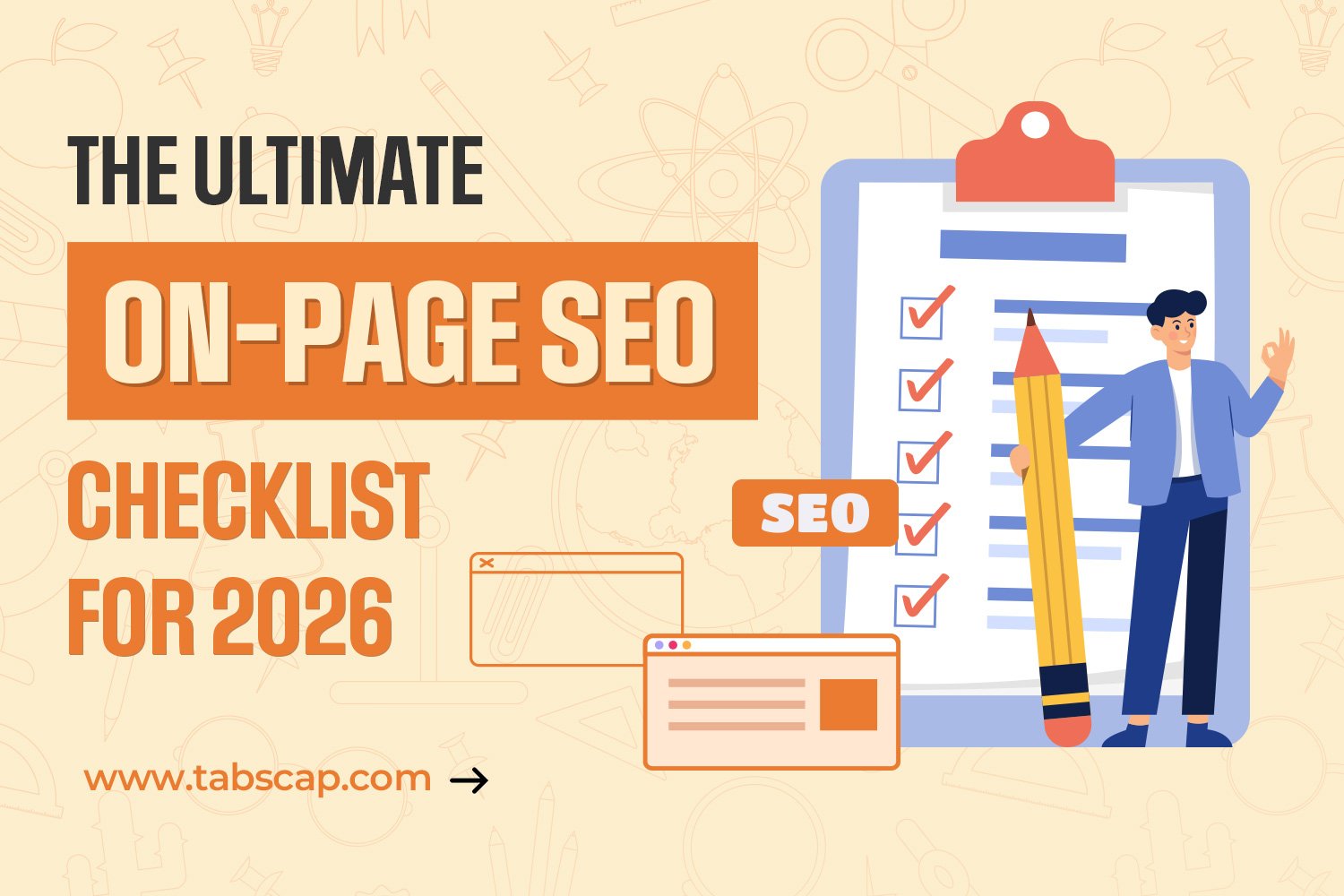
On-page SEO is no longer just about stuffing keywords into title tags and hoping Google notices. Search has fundamentally changed.
Google AI Overviews now appear on roughly 47% of all searches, and AI agents not humans are increasingly the first audience reading your content.
This guide gives you the complete, updated checklist every serious website owner, SEO professional, and content marketer needs to rank and stay ranked.
- 28% of all clicks go to the #1 organic result
- 47% of searches now trigger AI Overviews
- 62% of web traffic now comes from mobile
- of clicks go to results beyond page 1
Your Complete Checklist at a Glance
Click each item as you complete it to track your progress.
- Identify Target Keywords
- Align to Search Intent
- Optimize Title Tag
- Write H1 Tag
- Craft Meta Description
- Create SEO-Friendly URL
- Place Keywords Naturally
- Review E-E-A-T Signals
- Structure Header Tags
- Keep Content Fresh
- Build Internal Links
- Add External Links
- Optimize All Images
- Implement Schema Markup
- Hit Core Web Vitals
- Mobile-First Optimization
- Audit Crawlability
- Apply GEO Techniques
- Build E-E-A-T for AI
- Set Up Monitoring
Lay the Foundation Before You Write a Word
Great on-page SEO starts before you ever open your text editor. These steps define what you're optimizing for and why.
Step 01 — Keyword Research
Identify Target Keywords With Real Intent Data Keyword research is the bedrock of your entire on-page strategy. Choose the wrong keywords and no amount of optimization will save you. Choose the right ones and you're halfway to the first page before you even publish. Keyword selection requires evaluating three core dimensions simultaneously: Search Volume How many monthly searches does the keyword receive? Higher volume means more potential traffic, but also more competition. Keyword Difficulty How hard will it be for your specific domain to rank in the top 10? Look for "Personal KD%" in tools like Semrush. This is far more accurate than generic scores. Search Intent What does the searcher actually want? Ranking for a keyword that doesn't match your page's purpose results in high bounce rates and zero conversions.
How to Build Your Keyword List
Start with a broad "seed keyword" that describes your topic. Then use a keyword research tool to expand it: 1. Enter your seed keyword (e.g., "on-page SEO") 2. Filter by intent matching your page goal 3. Filter for Personal KD% under 40 if you're a smaller site 4. Aim for search volume of at least 300–500/month minimum 5. Check the SERP manually. Who's currently ranking, and can you beat them? 6. Note topically related terms you should include naturally (LSI/semantic keywords) Common Mistake Don't target one keyword per page in isolation. Build a keyword cluster. A primary keyword supported by 5–10 semantically related terms. This is how Google's algorithms understand topical depth in 2026.
Step 02 — Search Intent Alignment
Map Every Page to a Specific Search Intent Keyword difficulty and volume are nothing if your page doesn't satisfy what the searcher actually wants. Before writing a single word, analyze the top 5 ranking results for your target keyword and answer these questions: ? Content type: Are the top results blog posts, product pages, category pages, or landing pages? ? Content format: Are they how-to guides, listicles, comparison articles, or videos? ? Content angle: What's the unique slant? Beginner-friendly, data-driven, comprehensive, quick and actionable? If Google consistently ranks "best of" listicles for a keyword, publishing a single product page will not outrank them. No matter how optimized it is. Match the dominant content format. 2026 Note: Intent + AI Overviews Informational queries increasingly trigger AI Overviews. To get featured as a source, your content must directly answer the query in the first 200 words using clear, factual language. Structure matters as much as keyword usage. Phase 2: On-Page HTML Elements Optimize Every HTML Element That Signals Relevance These elements communicate your page's topic to both search crawlers and human visitors. Getting them right is non-negotiable.
Step 03 — Title Tag
Craft a Title Tag That Ranks AND Gets Clicked Your title tag is arguably the single most important on-page SEO element. It tells search engines what your page is about and serves as the main clickable headline in search results. ???? yoursite.com › seo › on-page-checklist On-Page SEO Checklist: 20 Steps to Dominate Search The most complete on-page SEO guide for 2026. Covers title tags, schema markup, Core Web Vitals, AI Overviews, and 17 more steps with examples.On-Page SEO Checklist: 20 Steps to Dominate SearchPrimary Keyword First · Benefit/Specificity Second · Under 55 Characters Title Tag Best Practices for 2026 RULE WHY IT MATTERS STATUS Primary keyword in first 3 words Google weights earlier terms more heavily Critical Keep under 55 characters Prevents truncation in SERPs on mobile and desktop Critical Include a compelling modifier "2026," "Complete," "Ultimate" improve CTR Recommended Match page content exactly Misleading titles = high bounce rates = ranking drops Critical No duplicate title tags Confuses Google about which page to rank for a keyword Critical Include brand name at end (optional) Increases recognition in branded SERPs Optional Do ? On-Page SEO Checklist 2026: 20 Proven Steps ? How to Lose Weight Fast: 12 Dietitian-Approved Tips ? Best Running Shoes 2026 (Tested & Ranked) Don't ? Home | My Website | SEO Page ? SEO SEO SEO: Get SEO Tips for SEO Success ? Page Title – A Very Long Title That Will Absolutely Be Cut Off in Google"
Step 04 — H1 Tag
Use One H1 Tag That Hooks and Informs Simultaneously Every page must have exactly one H1 tag. It's the on-page headline that both search engines and human visitors see first. While similar to your title tag, your H1 can be slightly longer and more descriptive since it doesn't get truncated. <!-- Correct: One H1 per page, keyword-rich, compelling -->
On-Page SEO Checklist 2026: The Complete 20-Step Guide to Ranking Higher
<!-- Wrong: Multiple H1 tags, weak, no keyword -->
Welcome to Our Blog
Latest Articles
H1 writing formula that works: [Primary Keyword] + [Specific Outcome or Number] + [Audience or Context]. For example: "On-Page SEO Checklist 2026: 20 Steps to Rank Higher and Get Featured in AI Overviews."
Step 05 — Meta Description
Write a Meta Description That Earns the Click Meta descriptions aren't a direct ranking signal, but they're one of the most powerful click-through rate (CTR) drivers you have. A compelling meta description can increase organic clicks by 20–30% without changing your ranking position at all. The anatomy of a great meta description: 1. Include your target keyword. Search engines bold matching terms, making your result visually stand out 2. State the clear benefit, what will the user gain by clicking? Be specific. 3. Add a soft CTA, "Discover," "Learn," "Explore," "See the full guide" all work well 4. Stay under 105 characters, longer descriptions get cut off on mobile, which makes up 62%+ of traffic Stop Google from Rewriting Your Description Google rewrites meta descriptions when it thinks yours doesn't match search intent. The fix: make your description clearly match the keyword's intent, use the exact keyword phrase, and keep it complete and non-truncated. The more accurately your description answers "why should I click this?" the less Google will rewrite it.
Step 06 — URL Slug
Create SEO-Friendly URLs That Humans and Crawlers Love Your URL slug is a small but meaningful ranking signal. More importantly, a clean URL builds trust with users before they even click. https://yoursite.com/seo/on-page-seo-checklist ? This is your slug. Keep it short, keyword-rich, hyphenated Good URLs ? /on-page-seo-checklist ? /best-running-shoes ? /email-marketing-guide Bad URLs ? /p?id=4892&cat=seo&y=2026 ? /the-ultimate-guide-to-on-page-seo-for-beginners-2026 ? /on_page_seo_checklist.html Changing URLs = Risk Never change a live URL without setting up a 301 permanent redirect from the old URL to the new one. Failing to do this destroys accumulated link equity and causes 404 errors for visitors and crawlers alike. Phase 3: Content Optimization Create Content That Outranks, Outserves, and Outlasts Content quality is measured by how completely and clearly it serves the searcher, not by word count or keyword density.
Step 07 — Keyword Placement in Body Content
Use Keywords Naturally, Strategic Placement, Not Stuffing Recent studies confirm there is no correlation between keyword density and high rankings. Top-ranking pages often have lower keyword density than their competitors. What matters is natural, contextual placement in the right positions. Where to Place Your Primary Keyword LOCATION WHY IT MATTERS PRIORITY First paragraph (within 100 words) Strong topical signal to crawlers Critical At least one H2 subheading Reinforces topic structure High Naturally throughout the body Semantic density and relevance Moderate Image alt text (where relevant) Contextual signal and accessibility Moderate Final paragraph or conclusion Reinforces relevance at page end Moderate Semantic SEO | The Keywords Around Your Keywords Modern Google uses natural language processing (NLP) to understand topical relationships. To prove your content is comprehensive, include semantically related terms that high-authority pages also use: ? For "on-page SEO": include terms like title tags, meta descriptions, header tags, internal links, schema markup, Core Web Vitals, search intent ? These aren't just synonyms. They're entities and subtopics that signal topical depth
Step 08 — Content Quality & E-E-A-T
Build Content That Demonstrates Real Expertise and Trust Google's E-E-A-T framework (Experience, Expertise, Authoritativeness, Trustworthiness) is central to how content quality is evaluated in 2026, especially for YMYL (Your Money, Your Life) topics like health, finance, and legal advice. Experience Has the author actually done what they're writing about? First-hand experience signals original photos, case studies, personal anecdotes powerfully differentiate your content from generic AI-generated text. Expertise Does the author have genuine subject-matter knowledge? Demonstrate this through clear explanations, accurate technical details, and content that goes deeper than surface-level summaries. Authoritativeness Is your site recognized as a trusted source by others? Build authority through quality backlinks, industry citations, brand mentions, and consistent publishing on your core topic. Trustworthiness Is your site safe and transparent? Use HTTPS, include clear author bios, cite credible sources, maintain accurate contact information, and keep content up to date. Content Quality Checklist QUALITY FACTOR WHAT GOOD LOOKS LIKE Accuracy All facts verified, statistics sourced, outdated info updated Originality Unique perspective, original data, or insight unavailable elsewhere Completeness Answers the main query AND all likely follow-up questions Readability Flesch–Kincaid Grade 8 or below for most audiences; short sentences, simple vocabulary Structure Scannable with H2/H3 headers, short paragraphs (2–4 sentences), bullet lists where appropriate Freshness Dates updated, stats refreshed, outdated advice removed
Step 09 — Header Tag Structure
Organize Content With a Logical H1–H6 Hierarchy Header tags aren't just formatting. They're your page's table of contents for both humans and AI. Search engines use headers to extract key topics, generate featured snippets, and build AI Overview answers. <!-- Correct header hierarchy -->
On-Page SEO Checklist 2026
? One only
Phase 1: Research & Strategy
How to Find Target Keywords
Understanding Search Intent
Phase 2: HTML Element Optimization
Optimizing Your Title Tag
AI Overview Tip Phrase some H2/H3 headers as questions (e.g., "What Is an H1 Tag?" or "How Do You Optimize a Meta Description?"). AI Overviews heavily cite pages where the subheading is itself the query the user typed and the paragraph immediately below it directly answers that question in 2–4 sentences.
Step 10 — Content Freshness
Regularly Update Content to Maintain Ranking Position Content freshness is a significant ranking factor for time-sensitive queries. Pages that once ranked well but haven't been updated in 12–18 months often experience "content decay” a gradual drop in rankings as fresher, more updated competitors outperform them. Content Refresh Checklist ? Update the publication date when you make meaningful changes (not just cosmetic edits) ? Replace outdated statistics with current data (with source links) ? Remove or update advice that no longer reflects current best practices ? Add new sections covering topics that have emerged since original publication ? Fix broken internal and external links ? Replace outdated screenshots or images ? Check that the page still matches the dominant search intent for the target keyword Phase 4: Links, Media & UX Build the Internal Architecture That Moves Rankings
Step 11 — Internal Linking
Build a Strategic Internal Link Network Internal links are how Google discovers, indexes, and understands the relationship between your pages. A strong internal linking structure distributes "link equity" from high-authority pages to newer or less-linked pages, helping your entire site rank better. Internal Linking Best Practices ? Use descriptive anchor text: Link text like "on-page SEO checklist" is far more useful than "click here" it tells Google exactly what the linked page is about ? Link from high-traffic pages to important pages: Identify your best-performing content and add internal links to pages you want to rank ? Fix orphan pages: Every page on your site should be linked from at least one other page orphan pages rarely rank ? Use topic clusters: Organize content into a hub-and-spoke model one comprehensive "pillar" page on a broad topic linked to and from several more detailed "cluster" pages ? Don't over-link: 3–5 internal links per 1,000 words is a sensible guideline. Excessive linking dilutes value Topic Cluster Model The most effective internal linking strategy in 2026 is the "pillar + cluster" model. One comprehensive pillar page (e.g., "Complete SEO Guide") links to and receives links from cluster pages (e.g., "On-Page SEO," "Technical SEO," "Link Building"). This tells Google you have deep, comprehensive coverage of a topic. Which is a major signal for topical authority.
Step 12 — External Links
Link to High-Authority External Sources Strategically Linking out to credible external sources, original research, authoritative publications, government sites, peer-reviewed journals signals to Google that your content is well-researched and trustworthy. It's a subtle but real credibility signal. ? Aim for 1–3 high-quality outbound links per 1,000 words ? Link to primary sources (the original study, not a blog post citing it) ? Open external links in a new tab to reduce bounce rate ? Avoid linking to competitors unless absolutely necessary for accuracy ? Use rel="nofollow" for paid links or untrusted sources
Step 13 — Image & Visual Optimization
Make Every Image Work Harder for Your SEO Images are one of the most overlooked on-page SEO opportunities. Properly optimized images improve page speed, appear in Google Image Search (a significant secondary traffic source), and provide semantic context to crawlers through alt text. Complete Image Optimization Checklist OPTIMIZATION HOW TO DO IT IMPACT File format: Use WebP or AVIF Convert JPEGs/PNGs to WebP using tools like Squoosh or an image CDN High Compress before uploading Use TinyPNG, ShortPixel, or Imagify; target  Phase 5: Technical On-Page Elements The Technical Layer That Powers Your Rankings
Step 14 — Schema Markup
Implement Structured Data to Win Rich Results Schema markup (structured data) is code added to your HTML that helps search engines understand the meaning of your content, not just the words, but the entities, relationships, and context those words represent. It's also a key factor in getting cited by AI Overviews. Article News, blog posts. Shows author, publish date, and headline in search. Product Price, availability, ratings. Essential for ecommerce pages. FAQ Expands your SERP listing with Q&A pairs. Excellent for AI Overview citations. Recipe Ingredients, cook time, ratings. Dominates food SERPs with rich cards. Local Business Address, hours, phone. Critical for brick-and-mortar local SEO. Review Star ratings in SERPs dramatically increase CTR for comparison pages. // Example: FAQ Schema in JSON-LD (most recommended format) Schema + AI Overviews FAQ schema and HowTo schema are among the most frequently cited content types in Google's AI Overviews. Implement them on informational and how-to content to increase your chances of being featured as a source in AI-generated answers.
Step 15 — Core Web Vitals & Page Speed
Hit Google's Performance Benchmarks or Lose Rankings Page speed is a confirmed ranking factor and in 2026, it has a second audience: AI agents. AI crawlers have retrieval timeouts of 1–5 seconds. A slow-loading page may never be included in an AI Overview, regardless of how good the content is. ? 2.5s LCP Largest Contentful Paint. Time for the main content to load. Target: under 2.5 seconds. ? 200ms INP Interaction to Next Paint. Responsiveness to user inputs. Target: under 200ms. ? 0.1 CLS Cumulative Layout Shift. Visual stability. Target: under 0.1 (elements shouldn't jump around). Top Page Speed Optimization Techniques ? Convert images to WebP/AVIF: Modern formats reduce file sizes by 30–70% vs JPEG with no visible quality loss ? Implement lazy loading: Only load images/videos as users scroll toward them ? Minify CSS, JavaScript, and HTML: Remove whitespace, comments, and unused code ? Eliminate render-blocking resources: Defer non-critical JavaScript; use async loading ? Use a CDN: Content Delivery Networks serve assets from servers geographically closer to the user ? Enable browser caching: Return visitors load your site from cache, not from scratch ? Upgrade your hosting: Shared hosting is often the single biggest speed bottleneck
Step 16 — Mobile-First Optimization
Optimize for Mobile | It's Now the Primary Ranking Version Google uses mobile-first indexing by default. This means the mobile version of your site is what Google crawls, indexes, and ranks. With 62.73% of all web traffic coming from mobile devices, this isn't optional. Mobile SEO Checklist ? Responsive design: Your layout must adapt fluidly to all screen sizes not just phone-sized, but tablet and large phone too ? Tap targets ? 44px: Buttons and links must be large enough to tap accurately on touchscreens ? Readable font sizes: Minimum 16px body text to avoid Google's "small font" warnings ? No intrusive interstitials: Full-page popups that cover content on mobile are a manual action risk ? Same content on mobile: Google's mobile crawler must be able to see the same content as desktop don't hide key sections behind accordions that don't open by default ? Pass Google's Mobile-Friendly Test for every key page
Step 17 — Robots.txt & Crawlability
Ensure Search Engines Can Find and Index Your Pages A perfectly optimized page is worthless if Google can't crawl it. A misconfigured robots.txt file is one of the most common and most devastating technical SEO mistakes. # robots.txt — check for accidental blocks # BAD: This blocks Googlebot from your ENTIRE site User-agent: Googlebot Disallow: / # GOOD: Allow all crawlers (default if no disallow rules) User-agent: * Disallow: # ALSO: Don't block AI crawlers if you want AI Overview coverage User-agent: OAI-SearchBot User-agent: PerplexityBot User-agent: anthropic-ai Allow: / Critical 2026 Note | AI Crawlers Blocking AI crawlers like OAI-SearchBot (ChatGPT), PerplexityBot, and Googlebot for AI Overviews means your content won't appear in AI-generated answers. Review your robots.txt carefully and whitelist crawlers you want to include your content. Also verify: ? Your XML sitemap is submitted to Google Search Console and Bing Webmaster Tools ? Key pages don't have noindex meta tags accidentally applied ? Canonical tags are pointing to the correct URL versions ? No pages return 404 errors that should be returning 200 (check Google Search Console's Coverage report) Phase 6: 2026-Specific Optimizations Future-Proof Your SEO for AI Search These three steps address the biggest shift in search since Google's founding: the rise of AI-generated answers. The AI Search Revolution Why Traditional SEO Is No Longer Enough AI Overviews now appear on ~47% of all searches. Studies show they reduce organic CTR by an average of 34.5% on the first organic result. But they also generate new impressions. The brands winning in 2026 are those optimizing for both traditional rankings and AI citation. ? 44.2% of all AI citations come from the first 30% of text your intro is your most important section ? Content depth (word count, sentence count) matters more for AI citation than traffic or backlinks ? ChatGPT prefers content with definite language, question marks, high entity density, and simple structures ? Pages that load faster are more likely to be included by AI due to retrieval timeout constraints
Step 18 — Generative Engine Optimization (GEO)
Optimize Content to Be Cited by AI Overviews and LLMs Generative Engine Optimization (GEO) is the emerging discipline of structuring content so it gets cited by AI systems. Google's AI Overviews, ChatGPT, Perplexity, and Gemini. The playbook is different from traditional SEO but complementary to it. GEO Optimization Techniques ? Answer Box Format: Structure your content so that each heading is a question and the first 40–60 words beneath it directly answer that question. This is the primary source format for AI citations. ? Factual Density: Include specific numbers, statistics, and data points. AI systems strongly prefer citing content with verifiable, specific claims over vague generalizations. ? Use Definitive Language: Avoid hedging with "some say" or "it's possible that." State facts confidently with sources. AI models are more likely to cite content that makes clear, direct claims. ? Add a Strong FAQ Section: FAQ sections are among the most frequently cited content formats in AI Overviews. Put your most important Q&As near the top of your page, not buried at the bottom. ? Entity Optimization: Explicitly name the key entities (people, places, brands, concepts) relevant to your topic. Google's knowledge graph rewards entity-rich content. ? Implement JSON-LD Schema: Structured data makes it significantly easier for AI systems to parse and cite your content accurately.
Step 19 — E-E-A-T Signals for AI Visibility
Build Author and Brand Authority That AI Systems Trust AI systems just like Google's quality raters evaluate whether a source is trustworthy before citing it. Building strong E-E-A-T signals is the single best investment for long-term visibility in both traditional and AI-powered search. Practical E-E-A-T Signals to Implement Today SIGNAL HOW TO IMPLEMENT Author bios with credentials Every article should have a detailed author bio linking to their LinkedIn, other published work, and relevant qualifications Expert review or quotes Have a recognized expert review or contribute to high-stakes content (health, finance, legal) Original research and data Conduct surveys, analyze your own data, publish original findings AI can't reproduce what only you have Citations and references Link to the original sources you're citing this builds a trust chain Brand mentions and PR Get your brand mentioned on authoritative news sites, industry publications, and credible directories Wikipedia entity If you're an established brand, a Wikipedia entry is a strong entity signal for AI systems
Step 20 — Performance Monitoring & Iteration
Measure, Learn, and Continuously Improve On-page SEO is not a one-time task. It's an ongoing cycle of optimization, measurement, and refinement. Set up a systematic monitoring process so you always know what's working, what's declining, and where new opportunities lie. Essential Monitoring Metrics METRIC TOOL REVIEW FREQUENCY Organic impressions & clicks Google Search Console Weekly Keyword rankings Semrush / Ahrefs / GSC Weekly Core Web Vitals scores PageSpeed Insights / Search Console Monthly Crawl errors & index coverage Google Search Console Weekly Content performance (time on page, bounce rate) Google Analytics 4 Monthly AI Overview appearances Semrush Position Tracking / manual checks Monthly Content decay (pages losing traffic) Google Analytics 4 + GSC Quarterly The Iterative SEO Cycle The most successful SEO teams operate on a 90-day review cycle: audit existing content for decay, refresh the top 20% of declining pages, publish new content targeting identified keyword gaps, build internal links to new pages, then measure results at the 90-day mark. Repeat. This checklist covers every on-page SEO signal that matters in 2026 from classic fundamentals to cutting-edge AI optimization. Bookmark it, work through it step by step, and revisit it every quarter.
Related Blogs